 Facebook
 X
X
 Pinterest
 Copy Link
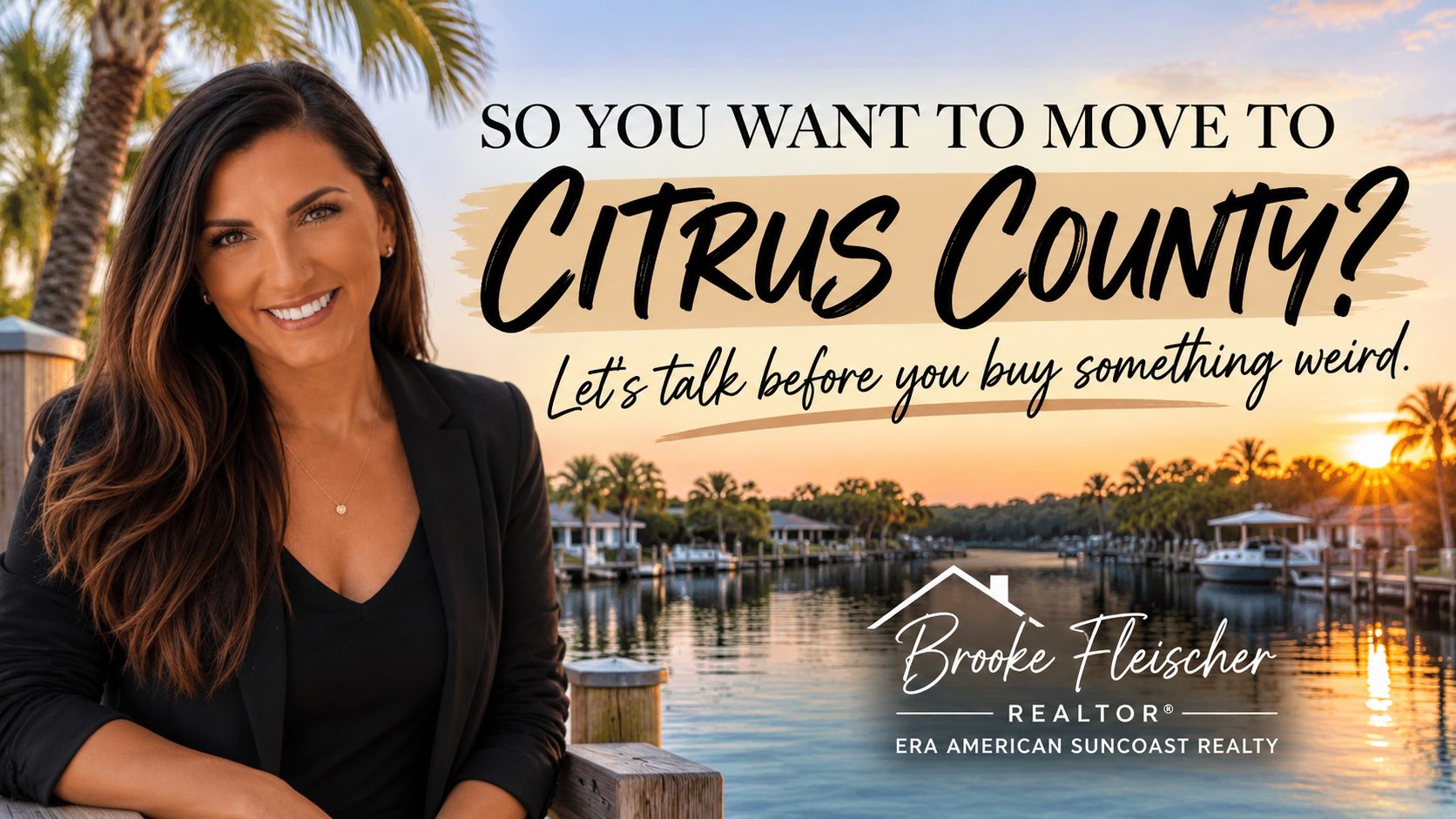
An actually useful guide to buying a home in Citrus County, Florida—from a local REALTOR® who isn’t going to tell you every beige house with gray vinyl plank flooring is “absolutely stunning.”
So, you’re thinking about moving to Citrus County.
Maybe you’re tired of traffic. Maybe you want more land and fewer neighbors. Maybe you visited Crystal River once, saw a manatee, and decided this is your entire personality now.
Honestly, fair.
Citrus County has a lot going for it—but Inverness, Crystal River, Hernando, Homosassa, Citrus Springs, Lecanto, and the surrounding communities are not interchangeable. And neither are the houses.
Before you start favoriting everything with a pool and convincing yourself that “the roof probably has a few years left,” there are some things we should talk about.
First: Figure Out Which Version of Citrus County You Actually Want
Citrus County isn’t one giant neighborhood with different ZIP codes slapped on it. Where you buy can completely change what your day-to-day life looks like.
Want to be closer to restaurants, shopping, schools, and that cute downtown feel? Inverness might make sense.
Want water, boating, fishing, manatees, and the ability to casually mention that you live near the Gulf? Crystal River and Homosassa are probably going to catch your attention.
Want more space, larger lots, or something that feels a little farther away from everything? Hernando, Citrus Springs, Lecanto, Pine Ridge, and the surrounding areas open up a whole different conversation.
And then there’s acreage.
Listen. I understand the fantasy.
Five acres. No neighbors breathing down your neck. Maybe some chickens. A giant garage. Your husband suddenly owns a tractor despite having absolutely no agricultural experience.
It’s a vibe.
But acreage can also mean wells, septic systems, more property to maintain, different zoning considerations, longer drives, and a whole list of things you probably weren’t thinking about when you saw the gorgeous oak trees in picture #17.
The point isn’t that one area is better than another. It’s figuring out how you actually want to live before we start looking at houses.
Because “Citrus County” can mean a lot of very different things.
Yes, We’re Going to Talk About the Roof
I know.
You walked into the house, saw the giant kitchen island, pictured yourself drinking wine there, and now I’m asking how old the roof is.
I’m such a buzzkill.
But welcome to buying a house in Florida, where “How old is the roof?” can become a surprisingly important question.
A roof’s age and condition can affect inspections, insurance options, future expenses, and whether that adorable house still feels quite as adorable once somebody starts throwing five-digit numbers around.
Florida does have protections surrounding roof age and homeowners insurance. For example, an insurance company can’t refuse to issue or renew a homeowners policy solely because a roof is less than 15 years old. And even once a roof reaches 15 years, age alone doesn’t automatically mean it’s toast—an authorized inspection showing at least five years of useful life remaining can matter.
Translation:
Old roof ≠ automatically bad house.
But it does mean we’re going to ask questions.
How old is it? What material is it? What’s the condition? Are there permits showing when it was replaced? What does the inspection say? And—very importantly—what does your insurance agent say?
Because we’re not finding out three days before closing that your beautiful new home comes with a surprise insurance problem.
That’s not the kind of closing gift I’m going for.
Flood Zone Doesn’t Mean Run. It Means Stop Panicking and Get the Facts.
We’re in Florida. There’s water. Sometimes the water gets ideas.
So yes, flood zones are something we’re going to talk about—especially if you’re looking around Crystal River, Homosassa, or other areas closer to the coast and waterways.
But seeing the word “flood” somewhere on a listing does not mean you immediately throw your phone across the room and abandon the house.
First, we figure out what we’re actually dealing with.
FEMA maps identify different levels and types of flood risk. Properties located in certain higher-risk areas—called Special Flood Hazard Areas—may require flood insurance when you’re using a federally backed mortgage.
And here’s the part people sometimes miss:
Being outside a high-risk flood zone doesn’t mean your house has been blessed with an invisible anti-water force field.
Flooding can happen outside those mapped high-risk areas too.
So before you buy, we’re going to look at the property’s flood-zone information, talk to your lender, get actual insurance quotes when appropriate, and make sure you understand what you’re signing up for before we’re emotionally committed to the screened-in pool.
Because “but the lanai was gorgeous” is unfortunately not an accepted form of financial planning.
The goal isn’t to scare you away from a house near the water.
It’s to make sure you know what owning that house may actually cost.
Please Don’t Fall in Love With the Listing Photos
Listing photos are a lot like dating profile pictures.
They’re supposed to show the property at its absolute best—and sometimes they’re working very hard.
That room that looked enormous online? Suddenly we’re standing in it wondering where the rest of it went.
That “cozy outdoor oasis”? That’s a patio chair next to an AC unit.
And that suspiciously bright kitchen photographed from the ceiling corner with a wide-angle lens? We’re going to need to see that in person.
Photos are great for deciding whether a home is worth touring. They are not a substitute for actually walking through it.
When we tour a property, we’re paying attention to things you can’t always see in pictures: the layout, smells, noise, neighboring properties, signs of moisture or damage, how the home has been maintained, and whether that fourth “bedroom” is actually a bedroom or a closet with ambition.
And no, I’m not your home inspector. If you decide to move forward, that’s when we bring in the professionals who know considerably more about crawl spaces than either of us ever wanted to know.
But seeing a home in person gives us context.
So if I tell you we really should tour a property before making a decision, I’m not trying to ruin your Saturday.
I’m trying to prevent you from purchasing a very expensive catfish.
That Five-Acre Property Is Sexy Until You Remember You Own Five Acres
Listen, I understand.
You want privacy. A big yard. Maybe a workshop. Maybe chickens. Maybe enough distance between you and your neighbors that nobody knows you’ve opened the second bottle of wine.
Respect.
And Citrus County has some beautiful properties that offer exactly that kind of space.
But acreage comes with questions that don’t always exist when you’re buying a house on a quarter-acre lot.
Is the property on well or public water? Septic or sewer? How much of the land is actually usable? Are there easements? What does the zoning allow? What are you planning to do with the property? Are there structures or additions that need to be researched? And who’s mowing all of this?
Because there’s a meaningful difference between:
“I’d love some land.”
and
“I would like to spend every Saturday maintaining my personal wildlife preserve.”
None of those things automatically make acreage a bad idea. In fact, for the right buyer, it can be exactly what makes Citrus County such an attractive place to live.
I just want you to fall in love with the reality of the property—not only the drone shot.
Please Talk to a Lender Before We Go House Shopping. I Beg You.
I know looking at houses is the fun part.
Talking about financing? Considerably less sexy.
But before we spend a Saturday touring six houses and you fall violently in love with house #4, we need to know whether house #4 actually makes sense for your budget.
And I don’t just mean the price on the listing.
Your monthly housing costs can include principal and interest, property taxes, homeowners insurance, possible flood insurance, HOA fees, and other expenses depending on the property.
Which means a $300,000 house is not automatically going to have the same monthly payment as another $300,000 house.
Florida likes to keep things interesting.
Getting pre-approved early gives us a realistic price range, helps us understand what your monthly payment may look like, and puts us in a much better position when you find the one.
It also prevents this deeply unpleasant conversation:
You: “Brooke, I’m obsessed with it.”
Me: “Fantastic. Can we afford it?”
You: “Define afford.”
Please don’t do this to me.
Talk to a lender. 😂
Congratulations, You’re Under Contract. Now Don’t Buy a Truck.
You found the house.
We negotiated. Your offer was accepted. You’re mentally arranging furniture and you’ve already figured out where the Christmas tree is going.
This is not the moment to celebrate by financing a new truck.
Or a boat.
Or an entire living-room set.
Or opening three credit cards because “Home Depot gave me 10% off.”
Your lender may continue verifying your finances and credit before closing, and major financial changes during this period can create problems with your loan.
So until you have the keys, please resist the urge to suddenly reinvent your financial life.
Don’t make large purchases on credit, open or close accounts, move large amounts of money around without discussing it with your lender, change jobs without telling them, or assume that because you were pre-approved three weeks ago nobody is paying attention anymore.
They are.
When in doubt, ask your lender before you do something—not afterward when we’re all developing stress-related eye twitches.
There will be plenty of time to buy the 84-month-financed emotional-support pickup truck after closing.
Let’s get the house first.
You Don’t Have to Know What You’re Doing. That’s Literally Why I’m Here.
You do not need to understand every step of buying a house before you call a REALTOR®.
You don’t need to already have a lender.
You don’t need to know what kind of loan you want.
You don’t need to understand inspections, appraisals, escrow, contingencies, closing costs, or why real estate apparently requires seventeen different people to send you seventeen different emails.
That’s my job.
Well, some of it is my job. Some of it belongs to lenders, inspectors, title companies, insurance agents, and other professionals who are much better at their respective jobs than I would ever pretend to be.
My job is to help you navigate all of it.
Ask me the question you think is stupid. Send me the Zillow listing at 11 p.m. Tell me you absolutely need a pool and then send me twelve houses without pools. Change your mind about the neighborhood. Decide you want acreage. Decide three days later that you’ve thought about mowing five acres and no longer want acreage.
We’ll figure it out.
Buying a home is a big deal. It doesn’t need to feel intimidating every second of the process.
And I’d much rather you ask me a ridiculous question than quietly make a very expensive assumption.
Need a Friend With Benefits?
Real estate benefits. Behave.
If you’re thinking about buying a home in Citrus County, Florida—whether that’s Inverness, Crystal River, Hernando, Homosassa, Citrus Springs, Lecanto, Pine Ridge, or somewhere in between—I’d love to help.
I’m Brooke Fleischer, REALTOR® with ERA American Suncoast Realty, and my approach to real estate is pretty simple:
I’ll answer your questions.
I’ll tell you what I know.
I’ll tell you when I don’t know and find the person who does.
I’ll help you understand your options.
And I’m not going to tell you a house is perfect just because we’d all like to go home.
So whether you’re ready to buy tomorrow or you’re currently lying in bed scrolling Zillow with absolutely no business looking at houses yet…
Hi. I’m Brooke. Let’s talk.
Brooke Fleischer, REALTOR®
ERA American Suncoast Realty
📱 352-467-8768
✉️ RealtorBrookeFL@gmail.com
